Deadwood removal
Taking out dead, dying, and broken branches so they don't fall on their own. This is the single most common safety pruning, especially on storm-battered maples and declining ash.
Tree trimming and pruning in Dearborn. Spot the signs a tree needs work, learn the process, and see how local weather shapes the timing.
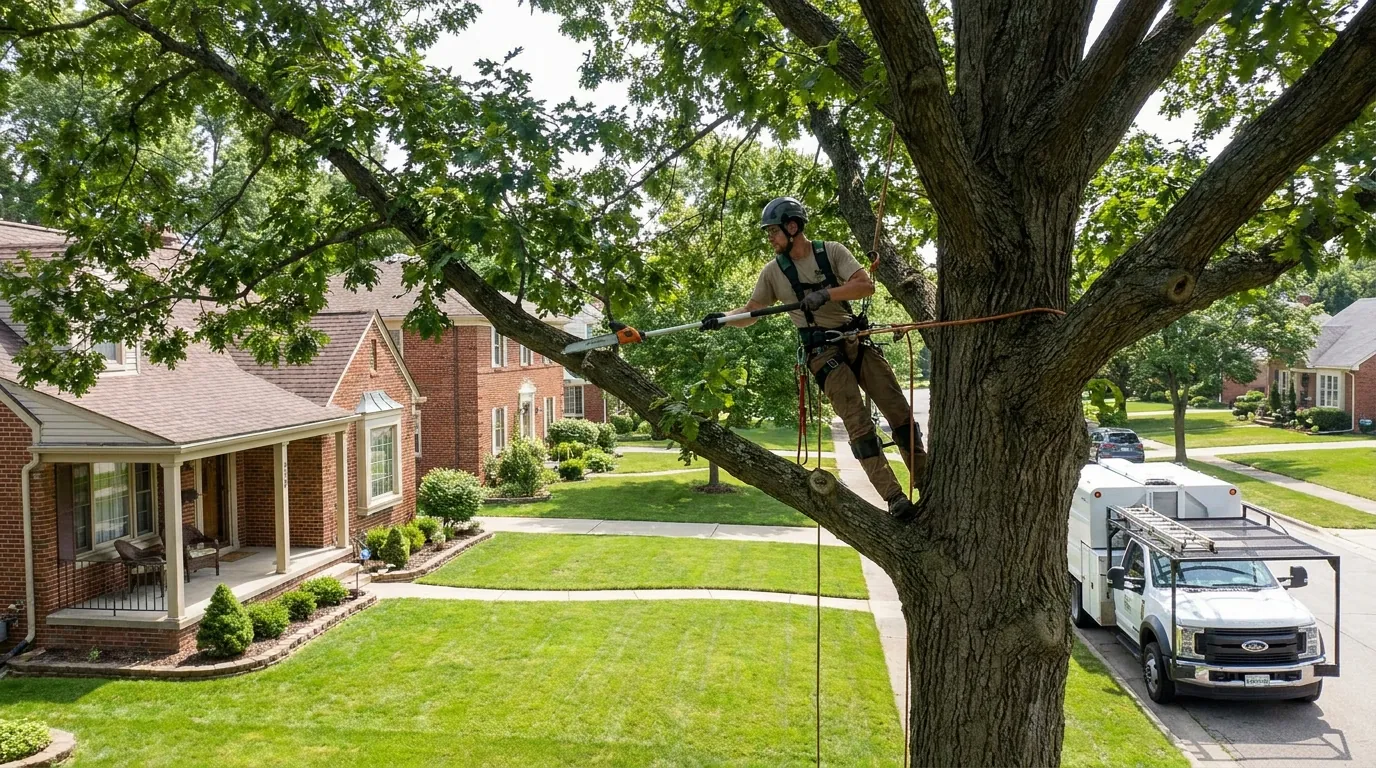
Not every problem tree needs to come down. A great deal of tree work in Dearborn is repair — pruning out dead and broken limbs, reducing a heavy or one-sided crown, clearing branches off a roof, and cleaning up after a storm splits a limb. Done at the right time and in the right places, this work extends the life of a tree and removes the hazard without the cost and loss of a full tree removal service.
People searching for a tree trimming near me are often responding to something specific: branches scraping the shingles, a limb hanging over the driveway after wind, a maple that leans toward the house, or a crown so dense that storms rock it. Each of those has a pruning answer. The trick is cutting to improve the tree's structure, not just its shape — bad cuts create weak, decay-prone wood that fails later.
Warning signs that a tree needs trimming or repair rather than removal include isolated dead branches in an otherwise healthy crown, limbs rubbing or crossing, a lopsided canopy pulling the trunk to one side, sucker growth low on the trunk, and torn or hanging limbs after a storm. If the trunk itself is failing or the tree is mostly dead, pruning will not fix it and removal is the safer route.
Different problems call for different cuts. Most jobs combine a few of these.
Taking out dead, dying, and broken branches so they don't fall on their own. This is the single most common safety pruning, especially on storm-battered maples and declining ash.
Selectively removing interior branches to let wind pass through a dense crown. Thinned trees rock less in the wind-driven fronts that come off the lakes.
Shortening long, heavy, or overextended limbs back to sound growth to relieve weight on a leaning or one-sided tree without topping it.
Cutting branches back from roofs, siding, driveways, and utility drops so limbs stop scraping and dropping debris on the structure.
Cleaning up torn and hanging limbs after wind or ice, making proper cuts at the break so the wound can seal instead of rotting.
When you prune matters as much as how. In southeast Michigan, the dormant season — late fall through late winter — is the best window for most structural pruning. The tree is not actively growing, wounds close cleanly as it wakes up, and with the leaves down the structure is easy to read. Frozen ground also lets crews work over a lawn without rutting it, the same advantage that makes winter good for removals.
Timing also protects against disease. Oaks in the Dearborn area should not be pruned in the warm months when oak wilt spreads through beetle activity; dormant-season cuts avoid that risk. Storm repair is the exception — a hanging, half-torn limb over a walkway is a hazard in any season and should be dealt with promptly rather than left for a better window.
Lake-effect moisture and heavy clay soils keep local trees growing vigorously, which means fast regrowth and denser crowns than drier regions see. That is why thinning and reduction here often need to be repeated on a cycle rather than done once. If a tree turns out to be too far gone to save, we will tell you plainly and point you to tree removal service instead.
Describe what the tree is doing — limbs on the roof, a lean, deadwood up top — and we'll tell you whether pruning solves it. Serving Dearborn and nearby towns.
Storm-damaged limbs are handled promptly, in any season.
If the trunk and root system are sound and the problems are limited to branches, pruning usually solves it. Removal is reserved for trees that are dead, structurally failing, or too close to a structure to keep. An on-site assessment settles which one applies.
Late fall through late winter is ideal for most structural pruning — the tree is dormant, wounds close cleanly, and frozen ground protects the lawn. Oaks specifically should avoid warm-season cuts to prevent oak wilt, and storm damage is repaired whenever it happens.
Yes, when done correctly. Thinning a dense crown lets wind pass through and reducing overextended limbs relieves weight that would otherwise snap. Topping a tree does the opposite — it forces weak regrowth — so we avoid it.
The lake-effect moisture and rich soils in this area drive fast regrowth, so many shade trees benefit from thinning or reduction every few years rather than a single one-time cut. We can suggest a reasonable cycle for your specific trees.