Tree Removal Service in Dearborn
Tree removal service in Dearborn and nearby towns. Warning signs, how the work is done, and how local soils and freezes shape the job.
When a tree needs to come out
A tree becomes a candidate for removal when it can no longer stand safely, when it is dead or dying, or when it sits so close to a house, driveway, or power drop that keeping it is a constant risk. In Dearborn's older neighborhoods — the streets around Ford Road, the University District, and the tightly spaced lots near Dearborn Heights — mature silver maples, ashes, and box elders often outgrow the space they were planted in, and the decision to remove them is as much about the yard around them as the tree itself.
If you are searching for a tree service near me because a limb dropped in the last storm or a trunk is leaning more than it used to, the first thing worth doing is reading the warning signs honestly. A tree removal service is the right call for trees that are structurally failing; for trees that are merely overgrown or unbalanced, tree trimming and pruning is often the better and less costly path.
Common signs a tree should be evaluated for removal include large dead branches in the upper crown, mushrooms or conks growing at the base, bark falling away in sheets, deep vertical cracks in the trunk, roots lifting out of the soil, and a lean that appeared or worsened suddenly. Ash trees across the Detroit metro area have been hit hard by emerald ash borer, and a dead ash left standing becomes brittle and dangerous quickly — those are frequent removals here.
How a removal is done
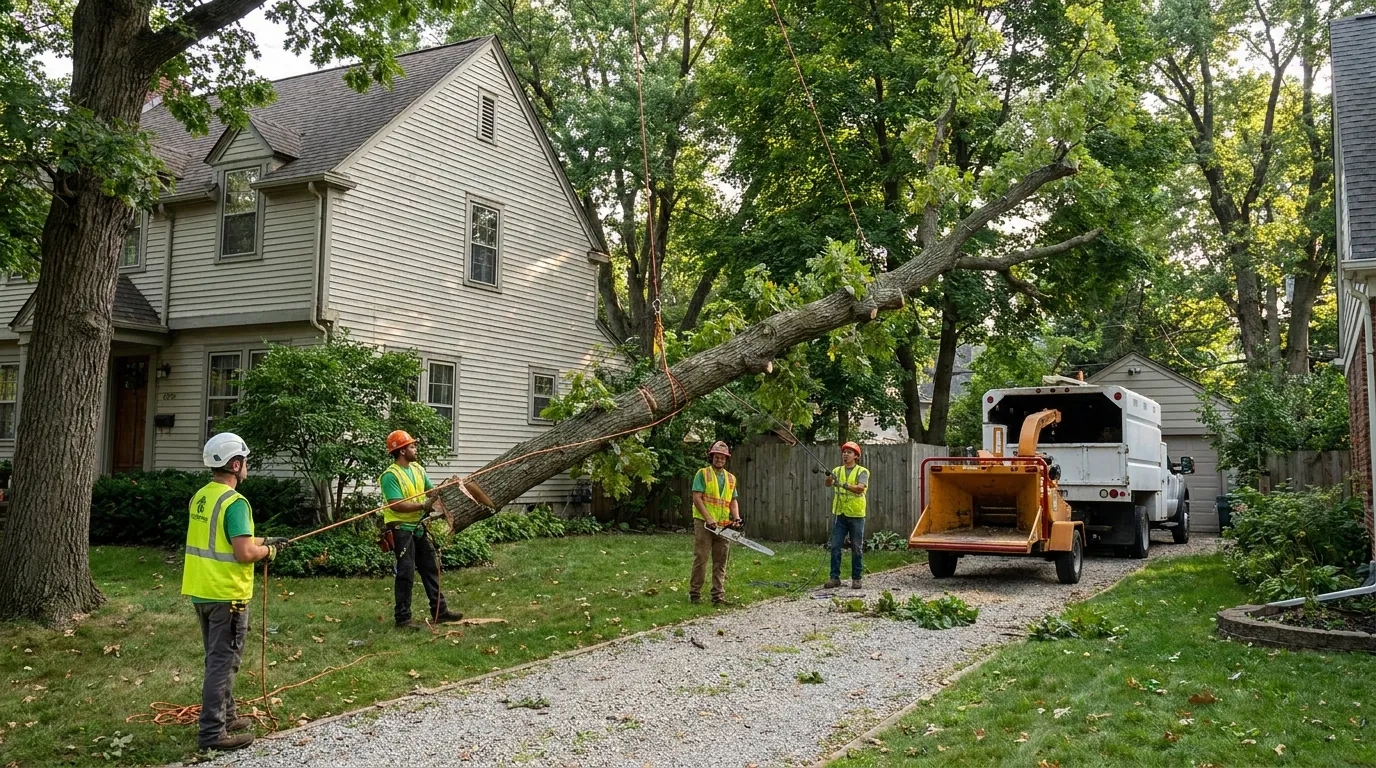
Every removal is planned around what is under and around the tree — the goal is to bring the wood down in controlled pieces, not to drop the whole thing and hope.
-
On-site assessment
We look at the tree's lean, the health of the trunk and roots, what is beneath it, and how much open space there is to work. On a tight Dearborn lot with a fence, a garage, and a neighbor's roofline in play, that assessment decides everything that follows.
-
Clearing the drop zone
Vehicles, patio furniture, and anything fragile are moved out of the fall path. Where there is no room to fell the tree in one piece, we plan a rigging setup to lower sections by rope.
-
Sectional takedown
A climber or a lift removes the crown limb by limb, then takes the trunk down in manageable rounds. Pieces are lowered or dropped into a cleared zone rather than allowed to fall freely near structures.
-
Stump handling
The stump can be cut low, ground below grade, or left depending on what you want to do with the spot afterward. Grinding is what makes the ground usable for new grass, a bed, or a replacement tree.
-
Cleanup and haul-away
Brush is chipped, logs are cut and removed or left as firewood if you want them, and the work area is raked so the yard is usable again the same day.
How Dearborn conditions change the job
Dearborn sits on glacial soils that run from sandy pockets to heavy clay, sometimes within the same yard. Clay holds water and drains slowly, which keeps root plates soft after the region's frequent lake-effect rain and snowmelt. A tree that looks solid in July can develop a lean by March simply because saturated clay lets the root ball shift. That is why a leaning tree here deserves a look even when it seems otherwise healthy.
Hard winter freezes matter too. Frozen ground is firmer to work over and easier on the lawn, and dormant-season removal means less mess from leaves and sap — winter is often the cleanest time to take a large tree out. In summer, saturated soil after a downpour can make heavy equipment risky on soft ground, so timing sometimes moves a job by a day or two.
The Detroit-metro storm pattern — wet, wind-driven fronts off the lakes — is what turns weak trees into emergencies. If a storm has already cracked a limb or split a trunk over your house, that is a hazard removal, and it is worth calling promptly. For planting a new tree once the old one is gone, see our tree removal installation page.
Get your tree looked at
Tell us what the tree is doing — leaning, dropping limbs, dead at the top — and where it sits on the lot. We serve Dearborn and nearby communities including Allen Park, Dearborn Heights, and Taylor.
Call for an on-site assessment before a hazard tree becomes a bigger problem.
Frequently asked questions
Do I need to remove the tree, or can it be saved?
Many trees that look bad are treatable with pruning to remove deadwood and rebalance the crown. Removal is for trees that are dead, structurally failing, or too close to a structure to keep safely. An on-site look is the only reliable way to tell which category yours is in.
How fast can a hazard tree be handled?
A tree that has already failed over a house or driveway is treated as urgent and scheduled ahead of routine work. Storm damage is common in the Dearborn area after wind-driven fronts, so describe the situation clearly when you call so it can be prioritized.
Will removal wreck my lawn?
On soft, saturated clay soil heavy equipment can rut a yard, which is one reason winter removals over frozen ground are often cleaner. We plan access and use rigging near tight spots to keep lawn and hardscape damage to a minimum.
What happens to the stump?
You choose. The stump can be cut low and left, or ground below grade so you can plant grass, a bed, or a new tree in the spot. Grinding is a separate step from the removal itself.
Which towns do you cover?
Dearborn plus surrounding communities including Allen Park, Dearborn Heights, Taylor, Southgate, Westland, and parts of Detroit.