Tree Health Assessment in Dearborn, MI
Tree health assessment in Dearborn, MI: an honest read on whether a tree is sound, treatable, or a hazard — before you decide to remove or keep it.
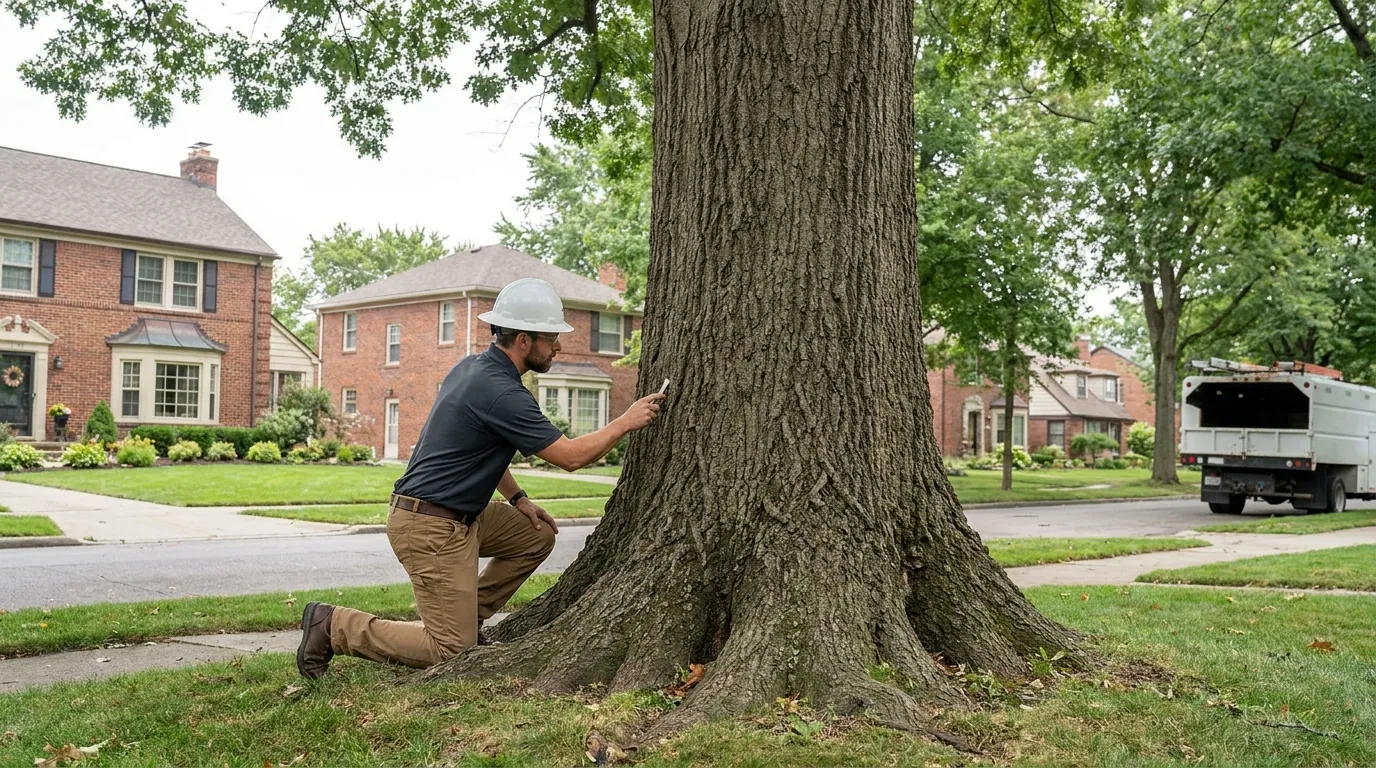
Know what you're dealing with before you decide
Most people call about a tree because something looks off — thinning leaves, dead branches, a lean, a fungus at the base — but it's hard to tell from the ground whether that's a death sentence or something a tree will shrug off. A tree health assessment is a close, methodical look at the tree so you can make the decision with real information instead of guesswork. Sometimes the answer is reassuring; sometimes it's that the tree is a genuine hazard and should come down.
This matters most for the big trees close to the house. A declining mature maple or a dead ash over the roof is a different conversation than a small tree at the back of the lot. An assessment is the step that keeps you from paying for tree removal you didn't need — or from leaving up a tree that should already be gone.
What an assessment looks at
We work from the roots up, because that's where many problems start and hide.
-
Root flare and base
We check the root collar for decay, fungal bodies, girdling roots, and soil heaving — signs the tree's anchorage may be compromised, which is critical in our water-holding clay soils.
-
Trunk and unions
We look for cracks, cavities, included bark where limbs join, and old wounds that have decayed inward — the structural weak points that fail in storms.
-
Canopy and growth
Deadwood, dieback at the tips, thin or off-color foliage, and unbalanced growth tell us how the tree is actually doing and whether a problem is advancing.
-
Pests and disease signs
We note indicators of the issues common here, such as emerald ash borer damage on ash and oak wilt risk, and whether a problem is treatable or terminal.
What the local conditions tell us
Dearborn's conditions shape what we expect to find. Clay soils that stay wet after our lake-moist springs stress roots and favor root-rot fungi, while hard freezes and freeze-thaw cycles enlarge trunk cracks year over year. The emerald ash borer has made dead and dying ash the single most common hazard tree in the area — and because dead ash goes brittle quickly, timing the decision matters.
The assessment ends with a clear recommendation: keep and monitor, prune to reduce risk with tree trimming, or remove. If removal is the call, we'll explain why so it isn't just our word for it. If it's a maintenance issue, you'll know what to do and roughly when.
Get a straight answer about your tree
Describe what's worrying you — the lean, the dead branches, the fungus — and we'll come look and tell you honestly where it stands. Serving Dearborn and surrounding towns.
Call during business hours to schedule an assessment.
Frequently asked questions
Can you tell if a tree is dying?
Often yes, from a combination of canopy dieback, bark and trunk condition, root-flare signs, and species-specific problems. Some trees are clearly declining; others need closer inspection to judge whether they're treatable or past saving.
My ash tree looks bad — is it the borer?
Emerald ash borer is extremely common in the Dearborn area, and signs include canopy thinning from the top down, D-shaped exit holes, and bark splitting. An assessment confirms it and whether removal is the safe next step, since dead ash becomes brittle quickly.
Will an assessment tell me whether to remove or keep a tree?
That's the whole point. You get a clear recommendation — keep and monitor, prune to reduce risk, or remove — with the reasons behind it so you can decide with confidence.
Do I need an assessment before a storm?
Checking your largest trees before storm season is a good idea, since weak unions, deadwood, and loose root plates are what fail in high wind. Catching them early often means pruning instead of an emergency later.