Deadwood removal
Taking out dead and dying branches, which are the first to drop in wind and the entry point for decay. This is the most common storm-season request in Dearborn.
Tree trimming service in Dearborn, MI: structural pruning, deadwood removal, and clearance cuts that keep trees healthy and safe through storm season.
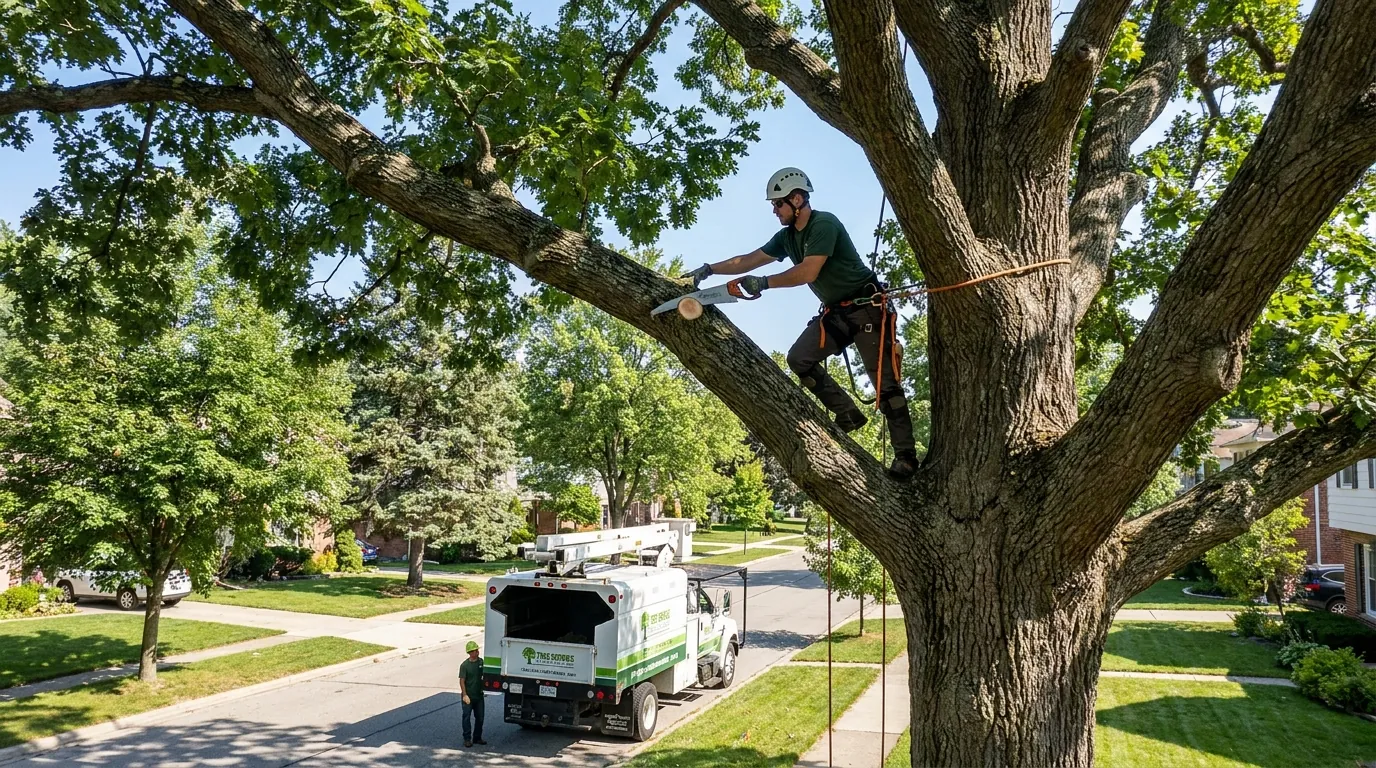
Good tree trimming is the difference between a tree that gracefully ages and one that tears itself apart in a storm. People looking for a tree trimming service near me often want branches off the roof or out of the power drop, but the bigger value is structural: removing weak, crossing, and dead limbs before they become the limb that fails. Done on a reasonable cycle, trimming reduces the odds you ever need a full removal.
Warning signs that a tree is due for trimming include dead branches holding on through summer, limbs rubbing the house or scraping the car, a dense crown that whips hard in wind, and sprouts crowding the center of the tree. On the maples, oaks, and lindens common in older Dearborn neighborhoods, well-timed pruning also keeps the canopy balanced so one heavy side doesn't overload the trunk.
The right cut depends on the tree and the goal — we don't top trees or make random stubs.
Taking out dead and dying branches, which are the first to drop in wind and the entry point for decay. This is the most common storm-season request in Dearborn.
Selectively removing crowded and crossing limbs so wind passes through the canopy instead of pushing against a solid wall of leaves.
Raising the canopy off a roof, driveway, or walkway, and pulling branches back from the house and service lines.
Shortening overextended limbs back to a sound side branch to reduce weight and leverage — a controlled alternative to removal for an oversized tree.
Our hard freezes and wet, lake-moist springs shape when pruning should happen. Dormant-season pruning in late winter is easiest to read — the branch structure is visible with the leaves gone — and the cuts heal cleanly as the tree wakes up. Oaks in particular are best pruned in the cold months to avoid attracting the beetles that spread oak wilt during the warm season. Light clearance and deadwood work can be done most of the year, but heavy structural pruning is better scheduled off the summer stress period.
Because Dearborn clay soils hold spring water and feed fast, soft growth, trees here can put on a lot of top-heavy canopy that catches summer storm wind. Thinning before storm season reduces that sail effect. If a tree is already too far gone to prune back to health, we'll say so and talk through tree removal instead — and if you only need the stump of a previously cut tree handled, that's stump grinding.
Tell us what's growing where it shouldn't be, and we'll recommend the lightest effective pruning rather than overcutting. Serving Dearborn and the surrounding Downriver and metro communities.
Call during business hours to book a trimming visit.
Late winter dormancy is ideal for most structural pruning because the branch pattern is visible and cuts heal cleanly in spring. Oaks should be pruned in the cold months to avoid oak wilt, while deadwood and clearance work can be done nearly year-round.
Many mature shade trees do well on a two-to-five-year cycle, depending on species and growth rate. Fast-growing silver maples and young trees being trained for good structure benefit from more frequent, lighter visits.
Proper pruning helps a tree by removing weak and dead wood and improving structure. Harm comes from topping or over-thinning, which we avoid — we never make random stub cuts.
We can clear branches around the service line that runs to your house. The high-voltage lines along the street are the utility's responsibility, and we'll tell you which is which.