Tree Removal in Dearborn, MI — When a Tree Has to Come Down
Tree removal in Dearborn, MI: warning signs a tree should come down, how the work is done safely in tight yards, and how local soils affect the job.
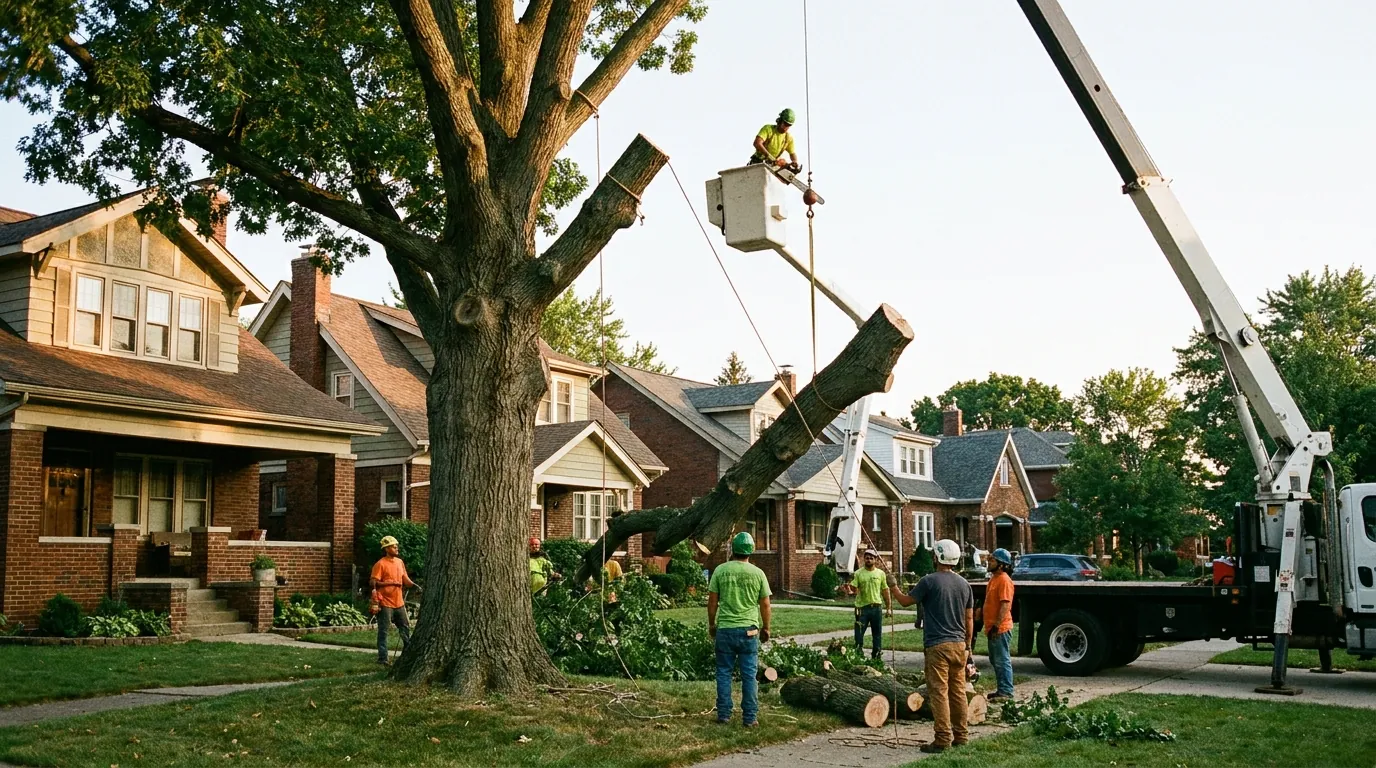
When tree removal is the right call
Not every troubled tree needs to come out, but some do — and in a built-up suburb like Dearborn the stakes are rarely just the tree. A large silver maple or ash leaning over a driveway, a split trunk after a windstorm, or roots lifting a foundation are all situations where removal is the safer, cheaper long-term decision. Searching for tree removal near me usually means something has already changed: new cracks, falling limbs, or a dead crown that didn't leaf out this spring.
Warning signs worth acting on include large dead branches high in the canopy, mushrooms or soft punky wood at the base, a visible lean that appeared suddenly, deep bark cracks, and heaving soil on one side of the root plate. Ash trees across the Dearborn area have been hit hard by emerald ash borer, and a dead ash becomes brittle fast — the longer it stands, the more dangerous and expensive it is to take down. If you are unsure whether a tree is salvageable, a tree health assessment is the honest first step before anyone brings in a saw.
How a removal is done
Removal in a residential yard is a controlled, piece-by-piece operation, not a single felling cut.
-
Site review and plan
We walk the tree, check the lean, the condition of the wood, and what sits below it — fences, gas meters, the neighbor's garage, overhead service lines. That determines whether the tree can be felled whole or must be climbed and dismantled in sections.
-
Sectional dismantling
In most Dearborn lots there is no room to drop a full tree. A climber or lift removes limbs and then the trunk in controlled pieces, often lowering heavy sections on rigging rope rather than letting them fall.
-
Felling where there is room
On open lots or cleared ground, a tree may be felled in one direction using a hinge cut, with the drop zone roped off first.
-
Cleanup and stump decision
Brush is chipped and wood is cut down or hauled. The remaining stump can be left low or removed with [stump grinding](/services/stump-grinding/), which most homeowners choose to reclaim the space.
How Dearborn soil and weather change the job
Dearborn sits on glacial soils that run from sandy pockets to heavy clay, and that mix matters for removal. Clay holds water through our wet springs and lake-effect moisture, so a shallow-rooted tree can loosen its root plate and begin to lean after a soaking rain even without high wind. Trees that look stable in July can shift in April. Hard winter freezes also stress the wood, and freeze-thaw cycles open existing cracks a little wider each year.
Our local storm pattern — summer thunderstorms off the lake and the occasional straight-line wind event — tends to find the weakest trees first. That is why so many removals here are not emergencies but overdue decisions: a tree that survived last year's storm with a cracked limb is the one that fails in the next one. If a tree has already come down or is hung up after a storm, that falls under emergency tree service rather than a scheduled removal.
Not sure if it has to go?
Send us the tree's location and a photo of what's worrying you, and we'll tell you honestly whether removal, trimming, or monitoring makes the most sense. We work throughout Dearborn and nearby communities.
Call during business hours to schedule a site visit.
Frequently asked questions
How much does tree removal cost in Dearborn?
Price depends on height, trunk diameter, species, lean, and access — a tall tree over a house costs far more than an open-lot removal of the same size. We give a firm quote after seeing the tree, never a blind number over the phone.
Do I need a permit to remove a tree in Dearborn?
Trees on private property are usually the owner's to remove, but street trees and some protected situations fall under city rules. Check with the City of Dearborn before removing anything in the right-of-way, and we can point you to the relevant department.
Can you remove a tree close to my house or fence?
Yes. Tight-access removals are the norm here, which is why we dismantle in sections and lower heavy pieces on rigging rather than dropping them.
What do you do with the wood and the stump?
Brush is chipped and wood is cut down or hauled off, depending on what you want kept. The stump can be left low or ground out separately with stump grinding.